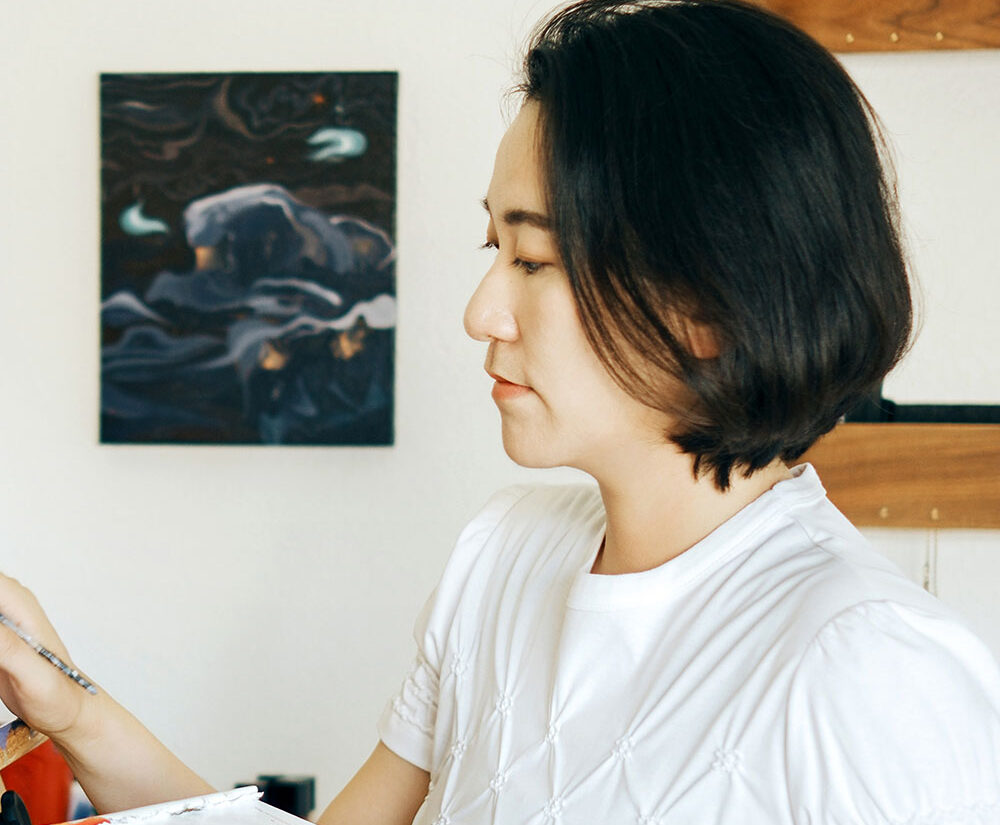
 : Your life and career have unfolded across Jiangsu, Hong Kong, New York, and the San Francisco Bay Area. Which of these places continues to shape the way you see, make, or inhabit the world most strongly?
Grace Zhang: Having lived in major cities in China and the United States, visited Paris regularly, and shared my life with a European spouse, I have built a life that spans three distinct regions of the world. These connections have given me a deeper understanding of their cultures and ways of life. My travels have also shaped a cosmopolitan outlook: rather than being bound to any single culture or set of ideas, I approach the world with openness and an independent mind.
These experiences have inspired me to look beyond cultural differences—to discover what we share and the underlying patterns and structures that connect us. This search for a deeper understanding of the world is also central to my art.
: You have developed a career in finance alongside a sustained painting practice. When did painting become more than a personal pursuit, and what has kept it essential to you over the years?
Grace Zhang I have loved art since childhood and spent much of my spare time learning through a wide range of resources. Coming from a family with a background in finance, I studied economics and finance at some of the world’s leading universities. Painting, however, remained a personal passion rather than my primary focus until 2022.
That year, I experienced a prolonged period of vestibular migraine, with dizziness triggered by light and loud sounds. Unable to look at a computer screen for work, I turned to painting as a way to find relief. What followed felt almost magical: when my brush touched the canvas, the dizziness would subside, only to return when I stopped painting.
Painting became a source of healing and a refuge from the daily stress of the financial markets. What had once been a hobby began to take on a deeper significance. I started to approach it more seriously, devoting myself to developing my practice and growing as an artist.
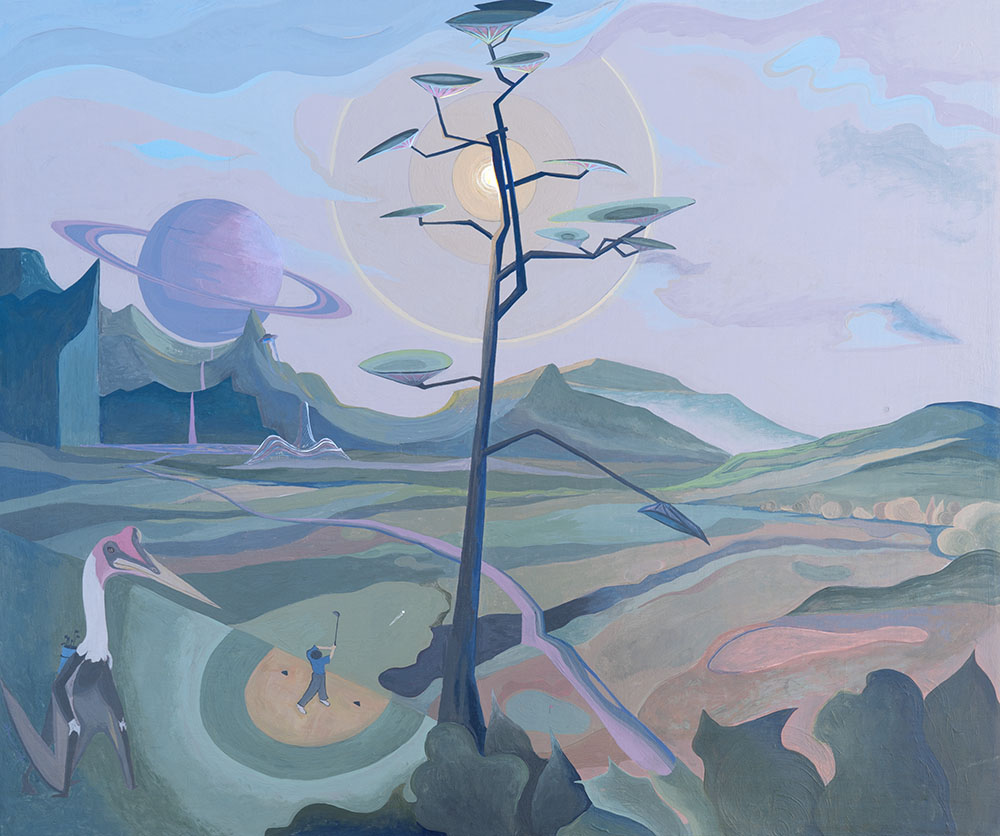
: Elliott Wave Theory is often associated with reading collective psychology through market patterns. What interests you about this idea, and how does it find its way into your visual language without becoming an illustration of finance?
Grace Zhang Elliott Wave Theory plays an important role in my investment practice. What interests me most is the idea that collective human psychology can take on a recognizable visual rhythm—a movement of advance and retreat, optimism and fear. I am drawn to the possibility of finding an underlying structure within these fluctuations.
In my paintings, these rhythms become a hidden compositional language rather than a direct illustration of finance. I might embed them in the contours of a mountain or in the underlying arrangement of forms—almost like invisible lines that guide the painting. The viewer does not need to recognize a market pattern to experience the movement it creates.
What I carry from investing into painting is not the chart itself, but a way of thinking about how emotion, repetition, and change can give rise to form.
: Dot and wave motifs recur throughout your work. Could you describe what they allow you to express—formally, emotionally, or philosophically?
Grace Zhang My dot and wave motifs come from a fascination with the dual nature of light—its particle-like and wave-like qualities. They give me two different visual languages to explore the same idea: dots suggest discrete points or individual presences, while waves suggest movement, continuity, and connection.
In my painting Quantum Whisper, I explore these ideas more explicitly through references to the double-slit experiment and Schrödinger’s cat. In most of my paintings, however, they appear more abstractly, woven into the composition rather than presented as scientific illustrations.
I particularly enjoy expressing waves from different perspectives—as lines, undulating forms, or rings. Changing their orientation and shape allows me to explore how the same idea can take on different appearances. Philosophically, these motifs connect to my search for an underlying structure beneath the visible world; formally, they offer an open-ended language for experimenting with rhythm, repetition, and movement.
: You have spoken of painting as a way of finding stillness within constant movement. What does “stillness” mean to you, and how do you create a space for it within a life shaped by professional intensity and travel?
Grace Zhang For me, stillness is not the absence of movement, but the ability to remain centered within it. My understanding is informed by Buddhist practices of calm and equanimity: being present with what is happening without being swept away by it.
In my paintings, I create this feeling through contrast—empty space against form, muted colors against saturated ones, quiet passages alongside areas of visual intensity. Stillness becomes more perceptible in relation to fullness. I do not want to remove the complexity of the world, but to create a place within it where the eye can rest and the mind can become more attentive.
In my own life, meditation, painting, and golf give me space for that same experience. Within a schedule shaped by travel and professional intensity, they offer opportunities to slow down and return my attention to the present. Painting is especially meaningful because it allows movement and stillness to coexist: my hand is moving, the composition is developing, yet I can feel quiet within that process.
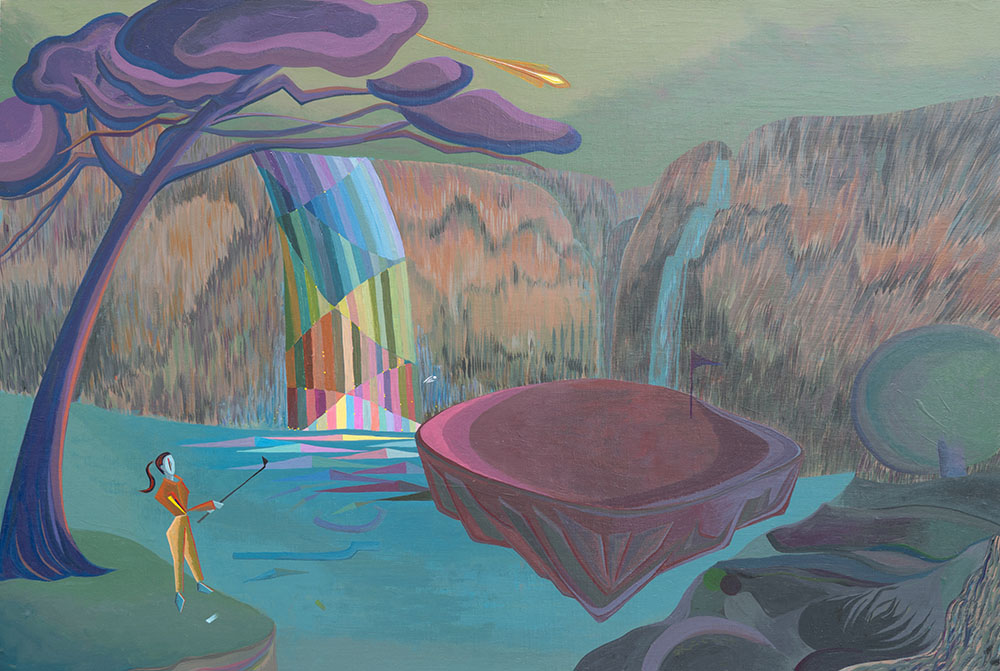
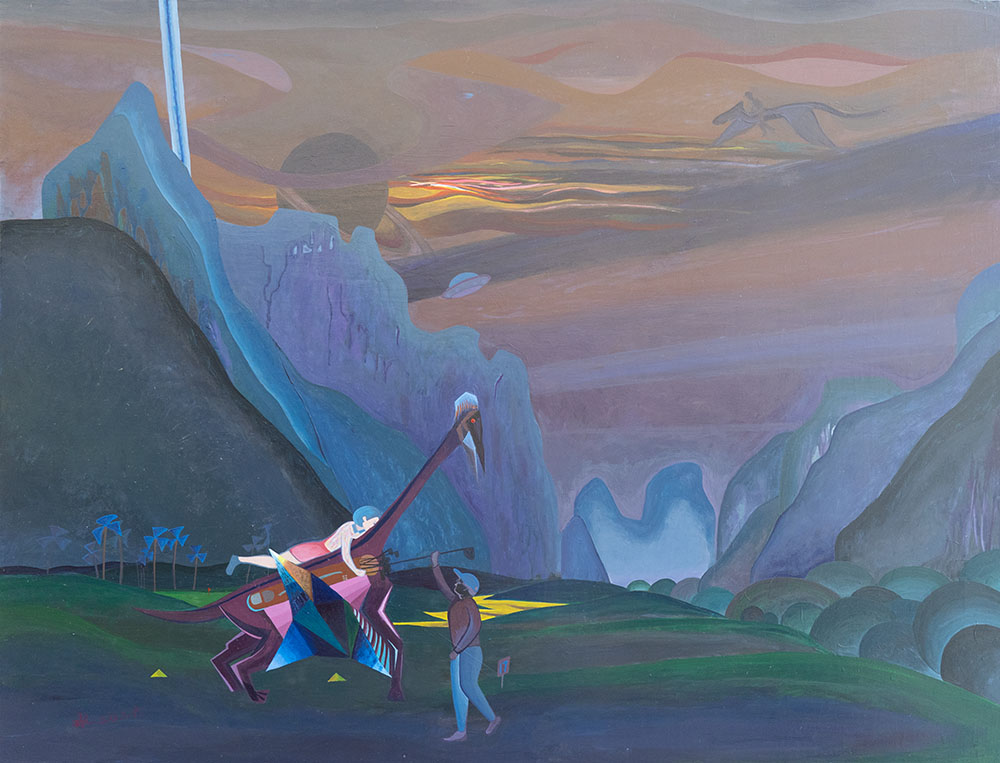
: Your influences range from Cézanne and Buddhist thought to fashion, travel, and the cosmos. How do these seemingly different references meet within a single painting?
Grace Zhang The central goal of my painting is to seek the underlying structures and principles of the universe—to uncover a truth beneath everything around us. Yet where artists like Mondrian or Rothko distilled the world toward pure form, my painting embraces the complexity of lived experience: the onslaught of impressions, narratives, and encounters, alongside my interests in travel, fashion, financial markets, and much more.
Weaving these elements together is an intricate process, closer to world-building than to distilling the world into a single essential form. In my paintings, Buddhist philosophy meets the structural logic I find in Cézanne, intertwined with many other ideas and influences. Building a painting feels like constructing a new architecture—one that requires multiple layers of thought, yet leaves room for intuition, discovery, and play.
That pleasure of discovery extends to the viewer. You can spend days or months with a painting and still find something you have never noticed before. Every painting in my self-portrait series contains a hidden lotus, representing the Buddha. Some are so deeply concealed that viewers struggle to find them. I always joke with my friends: if you really want to find the lotus, you may have to buy the painting and live with it.
: Spacetime Monologue marks the first public presentation of a practice you have developed privately for many years. What does it mean to bring this body of work into public view now, and how did you decide which works belonged in the exhibition?
Grace Zhang Spacetime Monologue marks the moment when a practice I have developed privately becomes a shared experience. After years of concentrating on making the work, I want to open that world to others and see how they connect with its different layers.
For this first exhibition, I chose breadth rather than a narrowly defined theme. I wanted the presentation to be as inclusive as possible, giving the audience an opportunity to encounter the different aspects of my practice and discover the connections between them.
In the future, I plan to develop more focused exhibitions, each exploring a particular area in greater depth. For example, I am planning a show in Paris that brings my couture pieces together with my art, exploring the dialogue between them. But for this first public presentation, it felt important to introduce the work as a whole—to let viewers enter the wider world before inviting them into its individual rooms.
: If you could invite viewers to spend time with one idea while standing before your paintings, what would you want that idea to be?
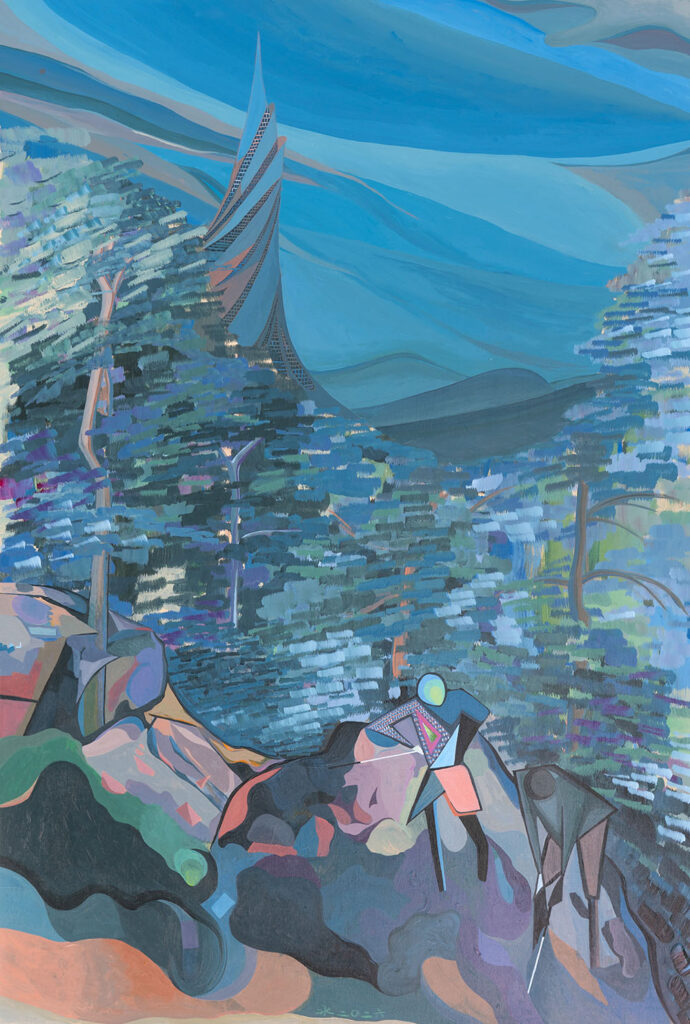
Grace Zhang I would invite viewers to consider the possibility that the past, present, and future can coexist—rather than seeing time only as a straight line, with one moment replacing another.
In my paintings, I want to create a space where memory, immediate experience, and imagined possibilities can meet. A painting can be encountered in the present while carrying traces of the past and opening toward something that has not yet happened. I hope viewers can pause within that space and feel time not simply passing, but unfolding in several directions at once.