Asian Voices, Global Conversations at Art Basel Paris 2026
By Raymond Dong
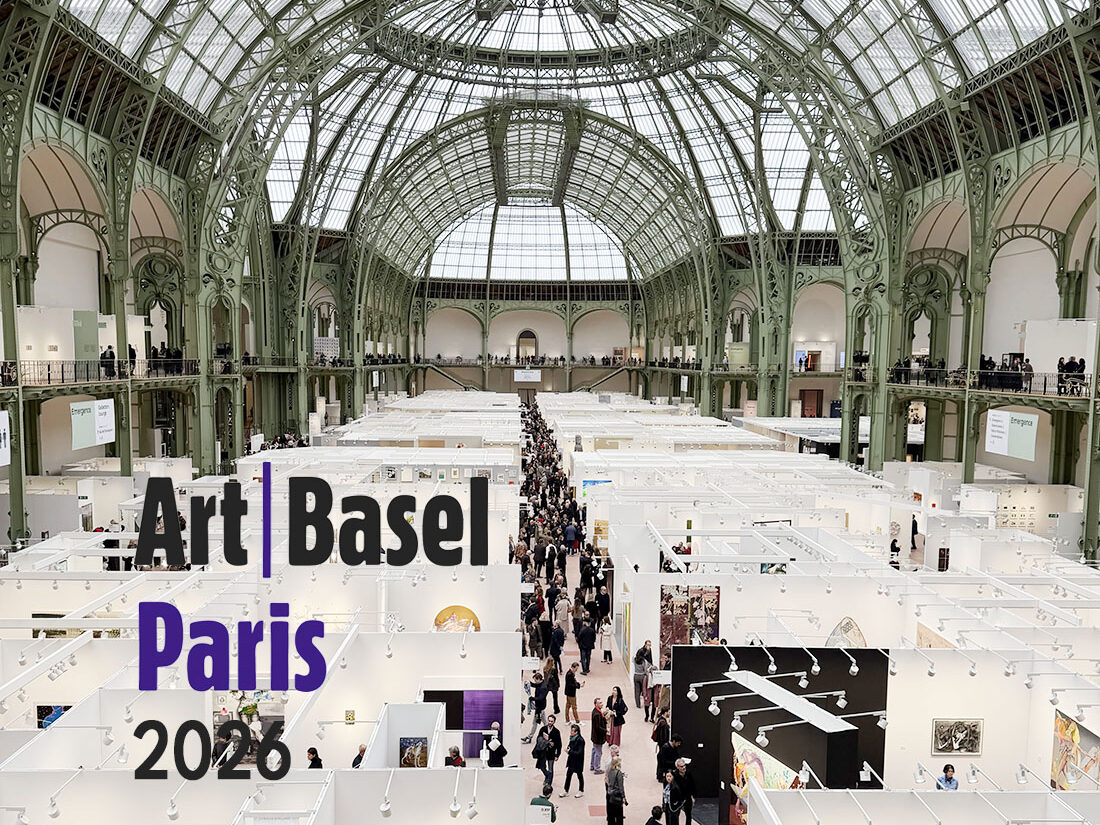
At Art Basel Paris 2026, beneath the monumental glass roof of the Grand Palais, contemporary art unfolds through an extraordinary range of materials, histories, and artistic perspectives. Amid the fair’s international presentations, works by Asian and Asian diasporic artists offer compelling ways of thinking about the relationship between personal experience and the wider world.
What connects these practices is not a shared aesthetic or a recognizable set of cultural symbols. Rather, it is the diversity of their approaches: from architectural interventions and transformed remnants of war to speculative bodies, digital identities, and quietly unsettling paintings.
Seen together, these works suggest that an Asian perspective in contemporary art is not a fixed category, but an evolving conversation.
Memory and Material
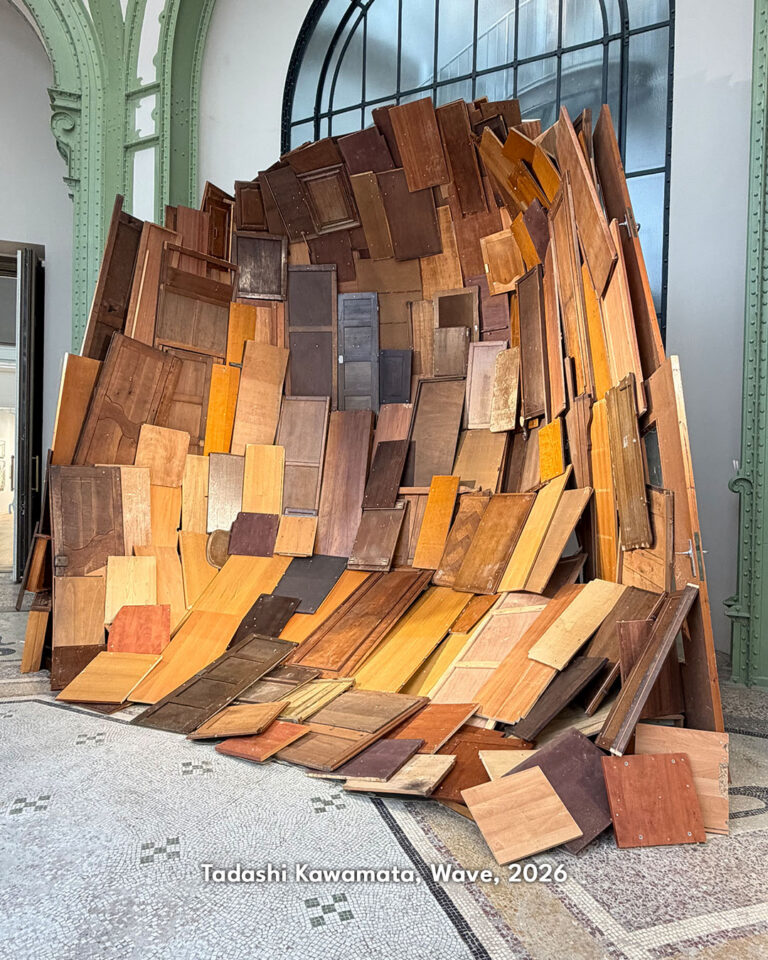
Japanese artist Tadashi Kawamata approaches architecture as a living accumulation of histories. In Wave (2026), an expansive construction of reclaimed wooden doors and furniture elements creates a sweeping form that transforms familiar domestic materials into something monumental.
The installation’s force comes from the tension between its individual components and its collective structure. Objects once associated with private interiors become part of a larger architectural gesture, carrying traces of use, movement, and displacement.
Kawamata’s work invites us to reconsider what happens when materials are removed from their original purposes. Their physical histories remain visible, even as they take on new meanings.
A different kind of material transformation emerges in the work of Vietnamese-American artist Tuan Andrew Nguyen.
Presented by Esther Schipper, Drift Glitch (2026) is a circular composition made from metal elements whose surfaces shift between gold, verdigris, and vivid red. Its layered structure initially recalls an abstract painting or an ornamental relief. Yet the work’s materials—brass transformed from artillery shell casings—bring a much more charged history into view.
Here, the afterlife of war becomes inseparable from the act of making. Metal once associated with violence is reorganized into a new visual language, one that holds questions of memory, migration, and historical inheritance.
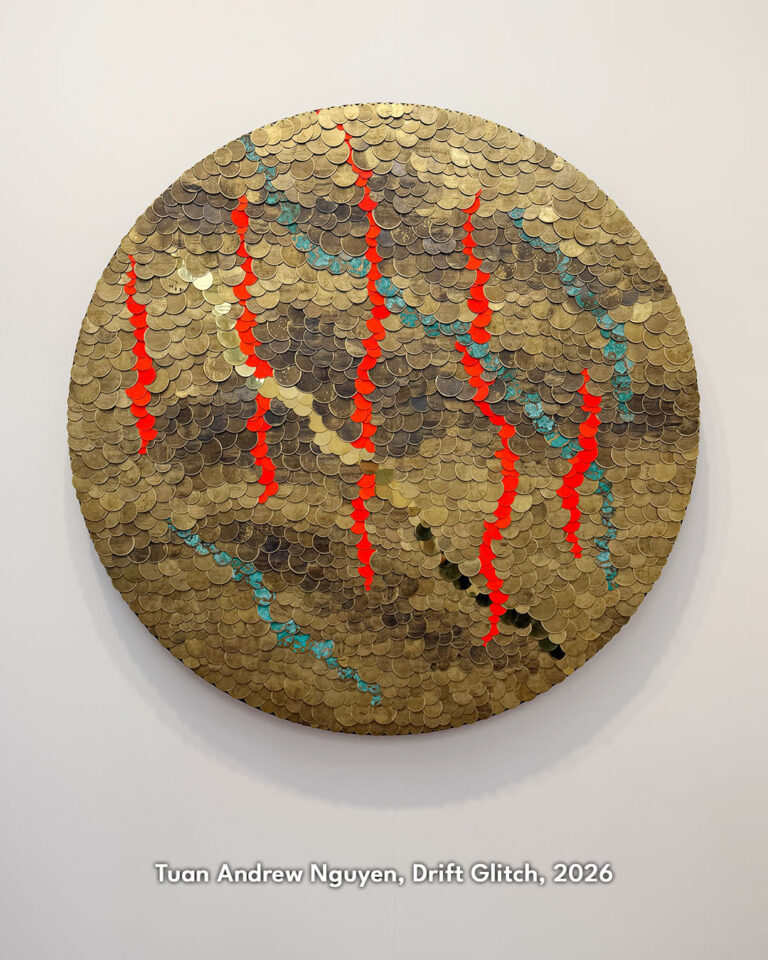
The contrast between Kawamata and Nguyen is revealing. Both artists work with materials that have already lived other lives, but their transformations lead in different directions: one toward the accumulated memory of everyday spaces, the other toward the persistent consequences of conflict.
For Chinese artist Zhang Yibei, material becomes a means of exploring an internal rather than explicitly historical condition.
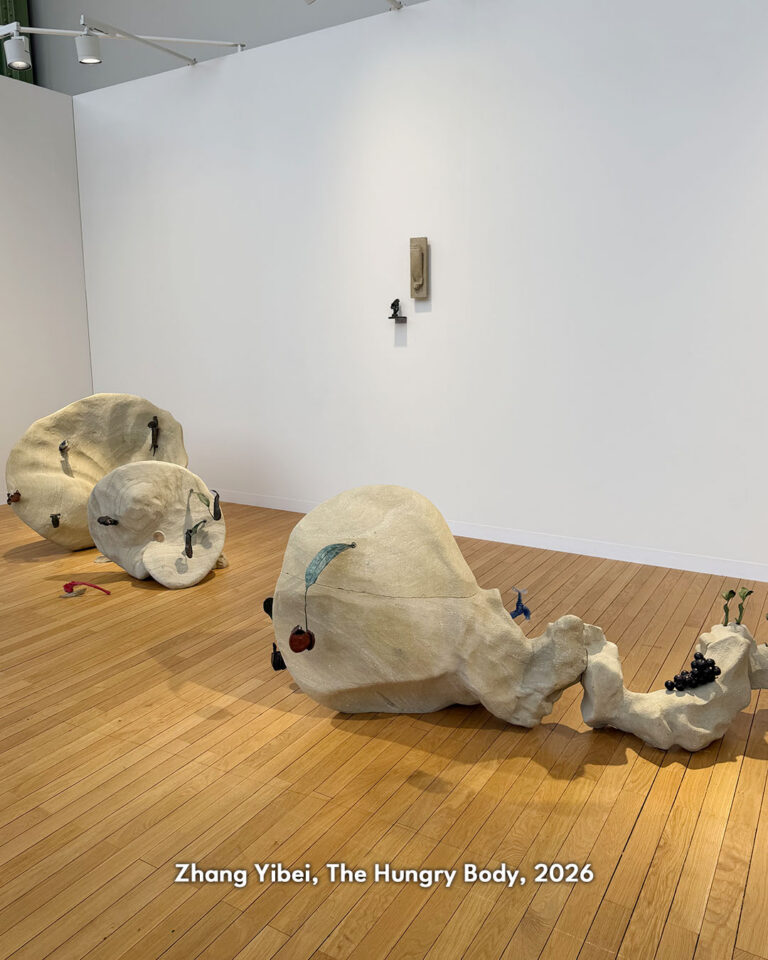
At BANK’s solo presentation, When the Hungry Body Calls for Freedom—What Does It Want?, her The Hungry Body sculptures (2026) combine sandstone, glass, and bronze in unfamiliar organic forms. Seeds, food-related objects, and plantlike details appear across surfaces that seem simultaneously vulnerable and substantial.
The exhibition expands the idea of hunger beyond physical need. Hunger becomes a metaphor for emotional absence, unfulfilled desire, and the recurring human impulse to compensate for what is missing.
The sculptures do not propose that these absences can simply be overcome. Instead, their strange, open-ended forms suggest that incompleteness itself may become a condition for imagination.
Bodies and Other Realities
If Zhang Yibei gives physical form to internal desire, South Korean artist Haneyl Choi treats the body as something far less stable than it first appears.
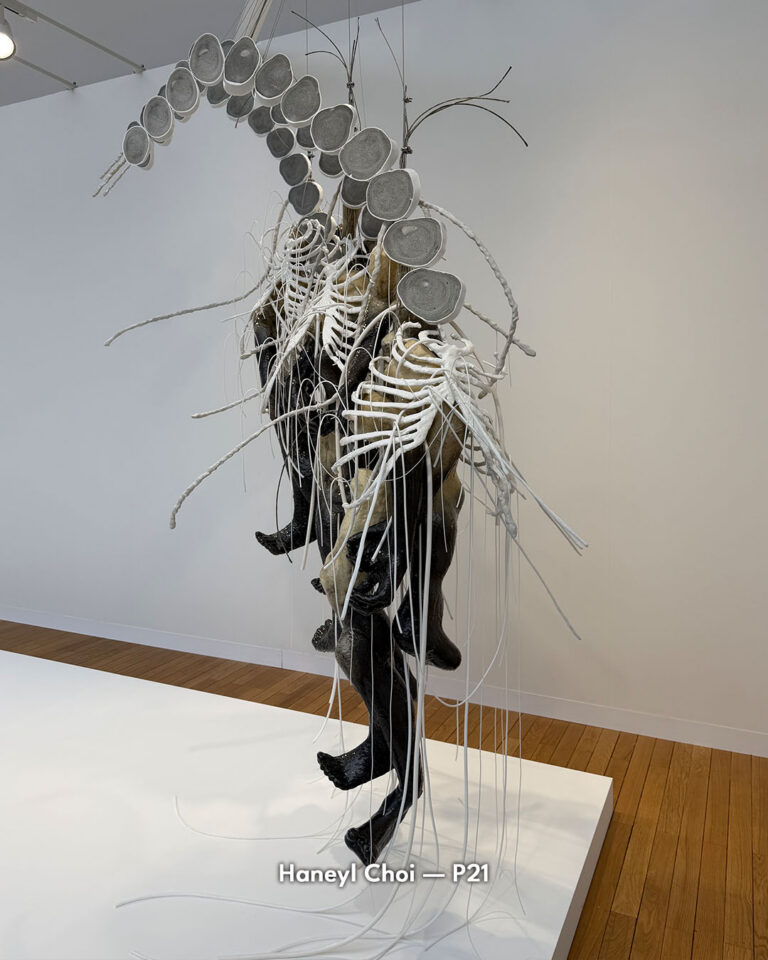
Presented by Seoul gallery P21, Choi’s sculptural installation brings together forms in which the human body seems suspended between recognition and disintegration. Dark humanlike figures and pale connecting structures create an unsettling relationship between anatomy, movement, and support.
The body here is neither a fixed identity nor a self-contained object. It becomes a shifting structure, open to transformation and uncertainty.
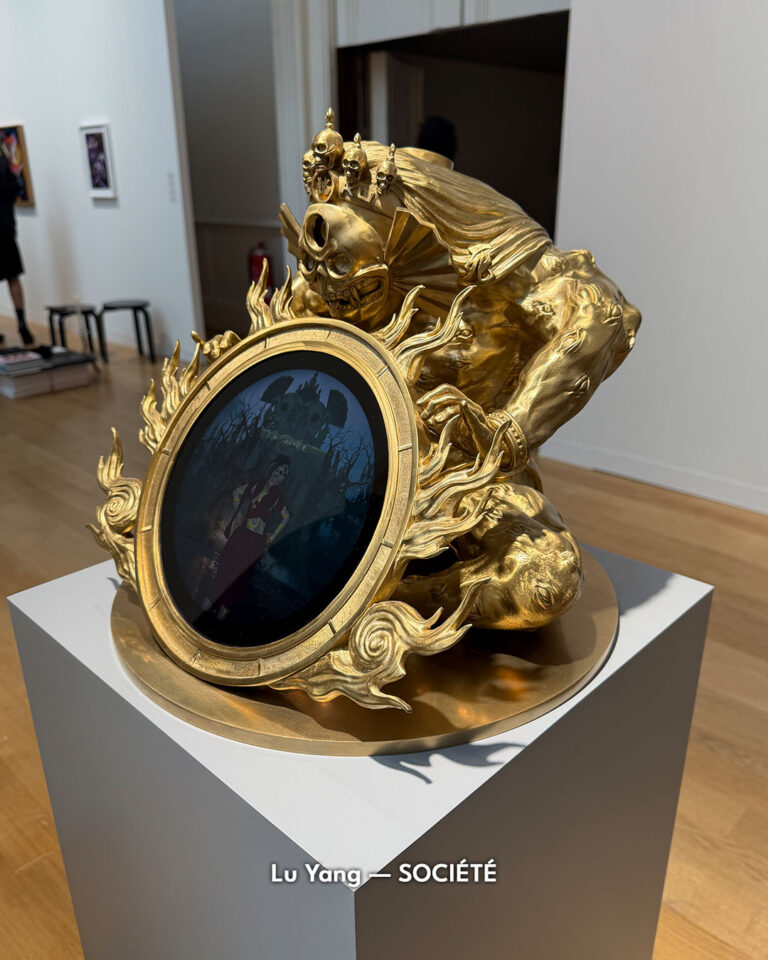
Choi’s exploration of bodily instability finds an unexpected counterpart in the work of Chinese multimedia artist Lu Yang, presented by SOCIÉTÉ, whose practice moves between digital imagery, spiritual iconography, and technologically constructed identities.
A richly ornamented golden sculpture incorporating a digital screen brings these different visual systems into close proximity. Its elaborate physical form suggests ceremonial or mythological imagery, while the moving image introduces an entirely different sense of time and presence.
Rather than presenting tradition and technology as opposites, the work allows them to coexist. The resulting encounter raises questions about what a body might become when identity, consciousness, and representation are no longer limited to physical form.
Placed alongside Choi’s sculptures, Lu Yang’s work reveals two distinct approaches to the contemporary body: one through the instability of physical matter, the other through the possibilities of digital transformation.
Painting, Perception, and Poetic Space
Not all of the fair’s compelling encounters announce themselves through scale or technological complexity.
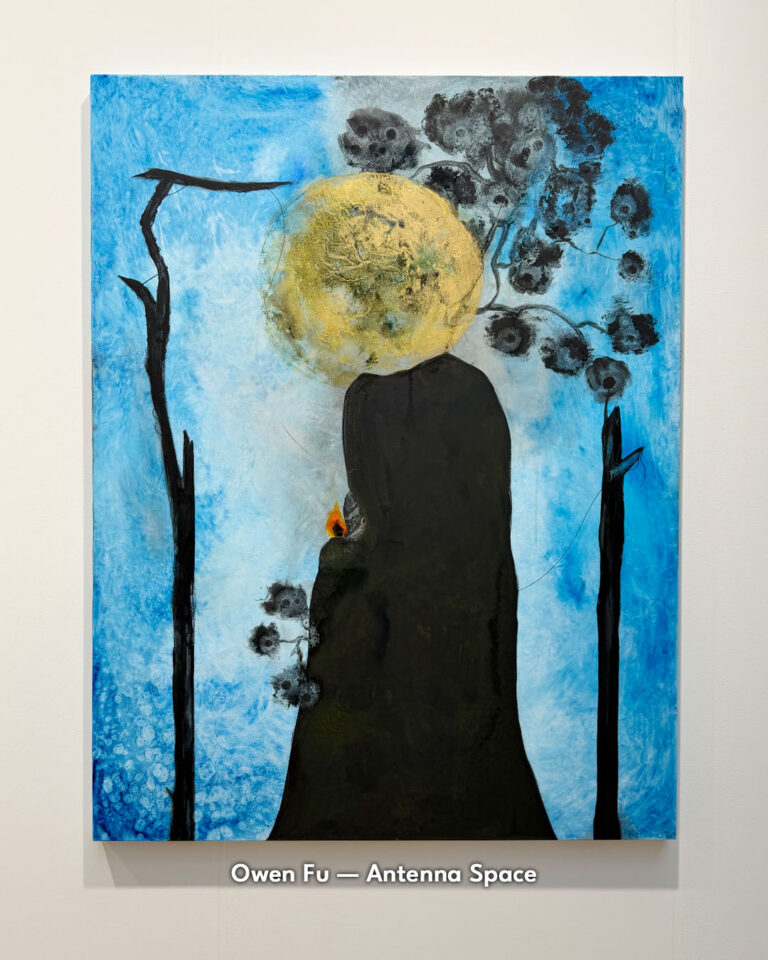
In a painting by Owen Fu, presented by Antenna Space, a dark figure appears against an intensely blue background, accompanied by a luminous golden circle and enigmatic botanical forms. The image feels at once intimate and elusive, as though drawn from a memory that resists complete reconstruction.
Fu’s painting invites prolonged looking without offering a definitive narrative. Its emotional atmosphere emerges from the relationship between recognizable imagery and the uncertainties surrounding it.
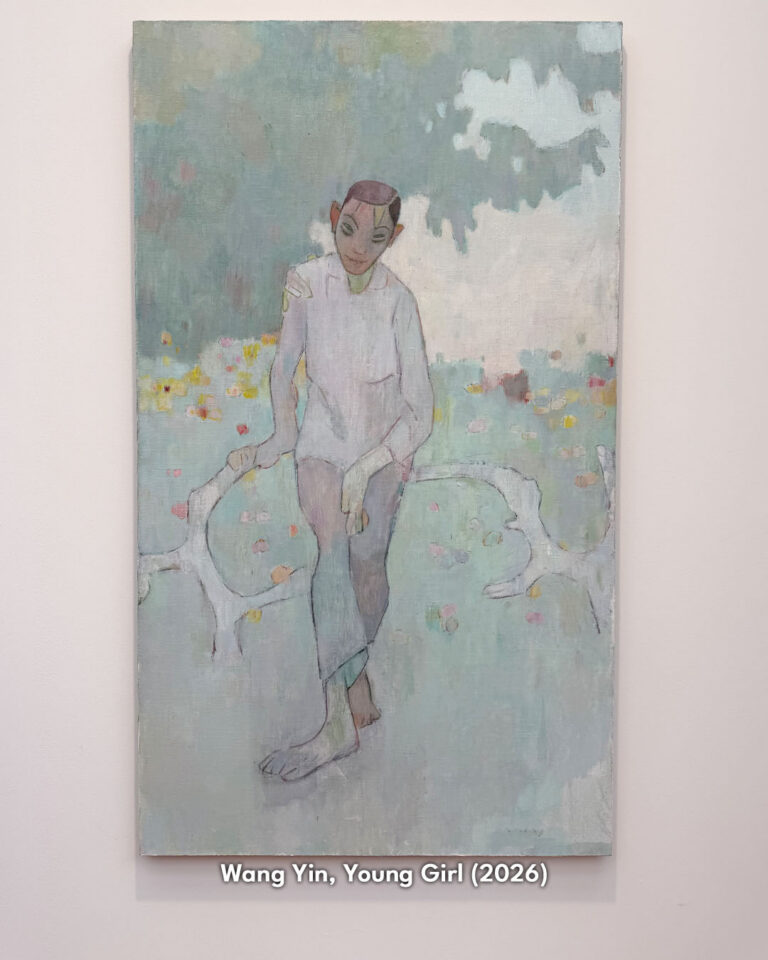
A similarly quiet tension appears in Wang Yin’s Young Girl (2026).
Rendered in muted green tones, the standing figure inhabits a space that seems suspended between ordinary observation and remembered imagery. The painting’s restrained palette and ambiguous setting create an uncertain sense of time.
Where Fu’s composition approaches the logic of a dream, Wang Yin’s painting seems to question how images acquire historical and emotional distance. Both demonstrate how contemporary figurative painting can remain psychologically complex without relying on dramatic gestures.
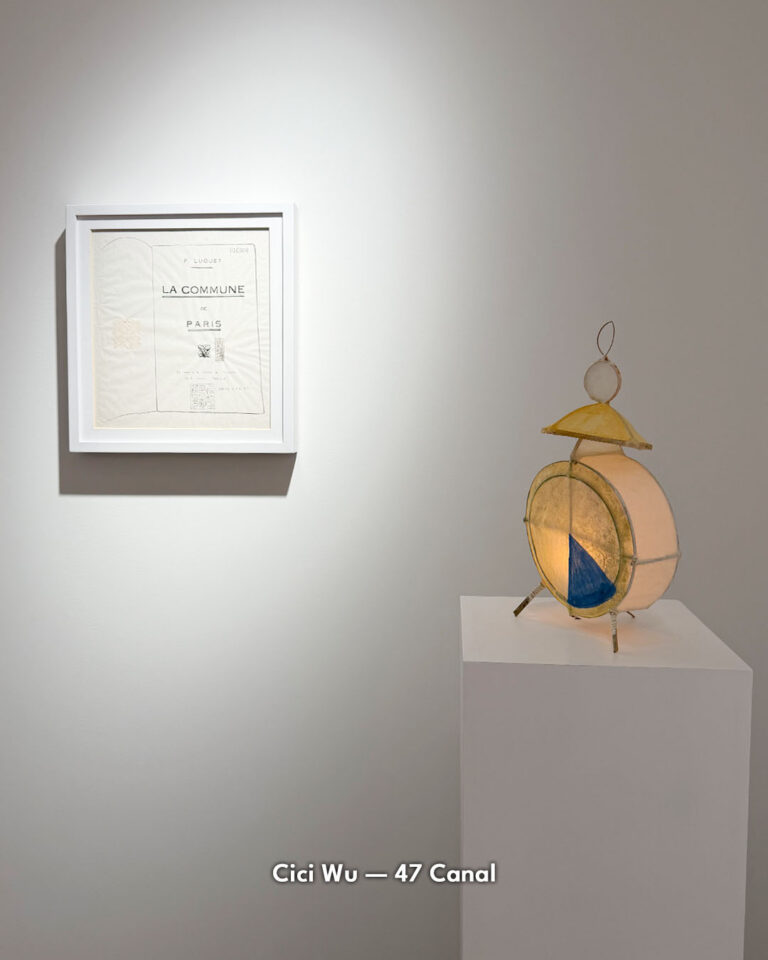
Cici Wu, presented by 47 Canal, offers another register of intimacy through an illuminated sculptural object that combines familiar shapes with an unexpected, almost animated presence.
Its warm interior light and modest scale contrast with the fair’s more monumental installations. The work draws attention to the emotional possibilities of ordinary objects, suggesting that perception can be transformed through the smallest shifts in material, illumination, and context.
Together, these quieter practices remind us that contemporary art’s capacity to provoke thought does not depend on spectacle. Ambiguity, restraint, and close observation can be equally powerful.
Lorem ipsum dolor sit amet, consectetur adipiscing elit. Ut elit tellus, luctus nec ullamcorper mattis, pulvinar dapibus leo.
Beyond a Singular Asian Aesthetic
The works gathered here resist easy categorization.
Kawamata transforms discarded architectural materials. Nguyen reworks the physical remnants of war. Zhang Yibei gives shape to psychological hunger. Choi destabilizes the human body, while Lu Yang explores its technological and spiritual possibilities. Fu, Wang Yin, and Wu turn toward the less tangible territories of memory, perception, and emotional experience.
Their artistic languages are markedly different, as are the histories and questions that inform them.
That difference is precisely what makes their presence at Art Basel Paris significant.
To view contemporary art through an Asian lens should not mean searching for a common visual identity or expecting artists to represent a single cultural narrative. It can instead mean paying closer attention to the many ways artists working across Asia and its diasporas contribute to—and challenge—the conversations shaping contemporary art.
At the Grand Palais, these conversations do not remain within geographic boundaries. They move through materials, bodies, histories, and images, becoming part of a broader artistic exchange.
What emerges is not one Asian voice, but a multiplicity of perspectives, each expanding the possibilities of contemporary art.